Forensic Accounts Payable: What Invoice Analysis Finds That Audits Miss
Traditional audits sample 5–10% of invoices and look for obvious errors. Forensic AP analysis examines every invoice. Here's what surfaces when you look at all of them.
Verse HQ
A statutory audit of a ₹120 crore mid-market company samples 8% of their 6,000 annual invoices. The sample is selected for documentation completeness, authorization, and obvious arithmetic errors. The audit passes. Twelve months later, a forensic review of all 6,000 invoices reveals ₹34 lakh in overpayments, ₹8.7 lakh in unclaimed delivery penalties, and one vendor with a systematic overbilling pattern going back 22 months. The audit was not wrong — it found what sampling can find. The forensic review found what only full-population analysis can find.
What Sampling Cannot Catch
Traditional audits are designed for financial statement assurance. They sample to test whether the controls are operating and whether the financial statements are materially correct. They are not designed to find every operational inefficiency or systematic vendor discrepancy.
Rate drift over time. A vendor's unit price increases 2% per month for 8 months. No single invoice exceeds the approval tolerance. But the cumulative drift is 17% above contracted rates. A statistical sample spread across the year might include two or three of these invoices, each of which looks normal individually. Full-history analysis sees the trajectory. This pattern is almost never detected by sampling.
Cross-vendor sequential patterns. Two vendors invoicing for similar services — with different names, different GSTINs, different invoice formats — but with amounts that interleave to stay below the CFO approval threshold. Each vendor's invoices look normal in isolation. The pattern only appears when you look at both vendors' invoices together over time, sorted by date and amount. Sampling selected by invoice, not by vendor relationship, misses this.
Penalty clause non-enforcement. The contract with a logistics vendor specifies a 2% penalty for delivery below 95% of ordered quantity. GRN data shows this vendor delivered between 88–93% consistently for 11 months. The ₹2.4 lakh in unclaimed penalties does not appear anywhere in the financial statements because no one calculated it. An audit looks for what was recorded, not for what should have been claimed but wasn't.
Systematic TDS rate errors. A vendor category has been taxed at Section 194C (2%) when 194J (10%) applies. The discrepancy on any individual invoice is small. Across 40 invoices over 14 months, the under-deduction is ₹3.1 lakh plus compounding interest. An audit sample might include two invoices from this category, both of which are internally consistent — the error needs the full vendor transaction history to surface.
Vendor GST filing risk patterns. A vendor with reliable GSTR-1 filing history becomes a delayed filer in months 10 and 11. The ITC associated with their invoices for those months has not appeared in GSTR-2B. This is not an invoice error — it is a relationship signal that requires attention. Point-in-time audit sampling does not track behavior over time.
What Forensic AP Analysis Does Differently
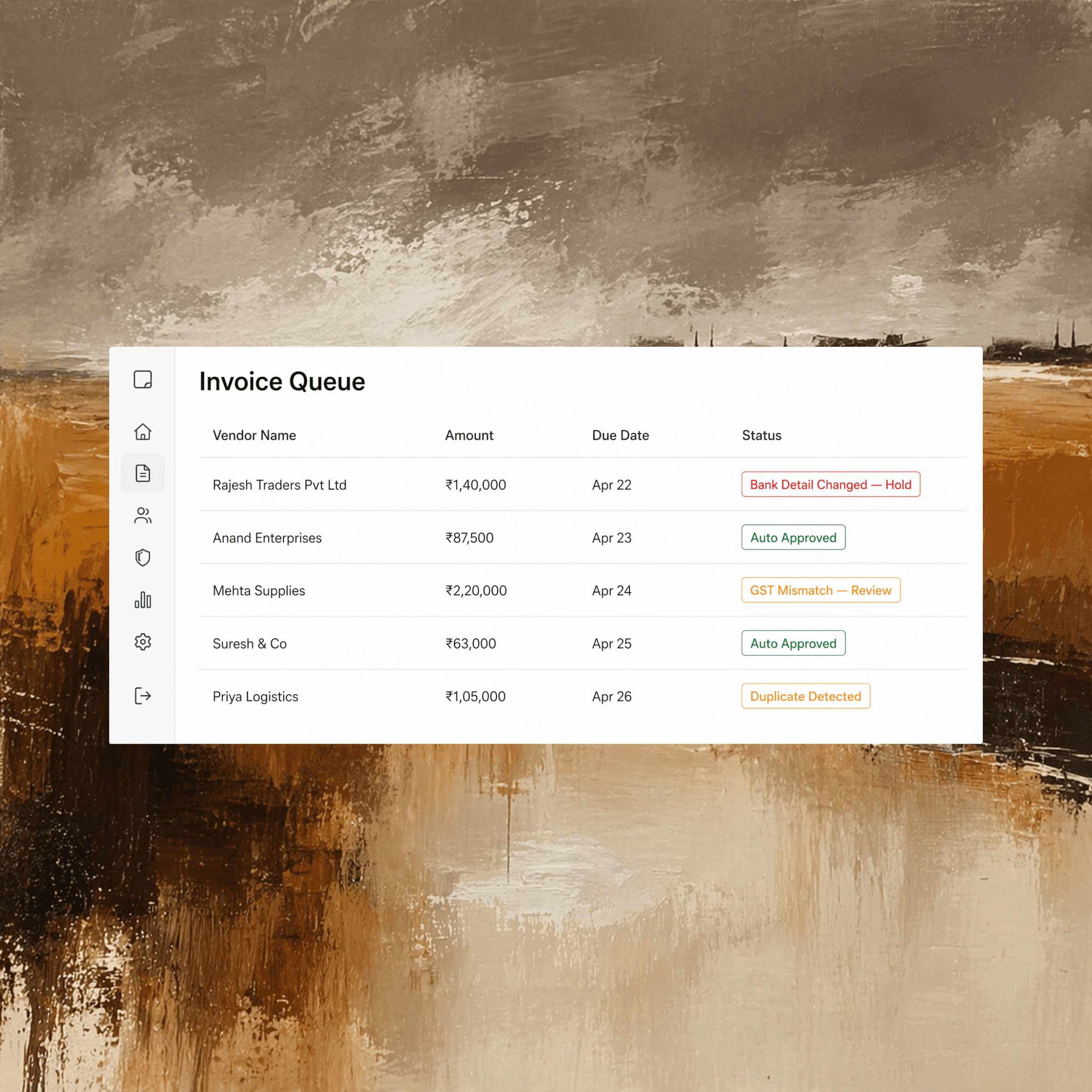
Forensic AP analysis, as implemented in platforms like Verse HQ, operates on every invoice, every month, rather than on periodic samples. It cross-references each invoice against its PO, GRN, contract, vendor master, and historical transaction data simultaneously. The output is not a list of errors — it is a pattern analysis that identifies where systematic discrepancies exist, how long they have been accumulating, and the specific rupee impact.
The value of continuous forensic analysis over periodic auditing is not just about finding more. It is about finding things early enough that the recovery is still straightforward. A price discrepancy discovered on invoice 3 can be corrected with a credit note. A price discrepancy discovered on invoice 47 requires a vendor negotiation, a legal review of the contract, and a recovery discussion that damages the relationship.
The forensic approach to accounts payable is not a post-facto investigation. Run continuously, it is an early-warning system that surfaces operational and compliance risks before they compound.