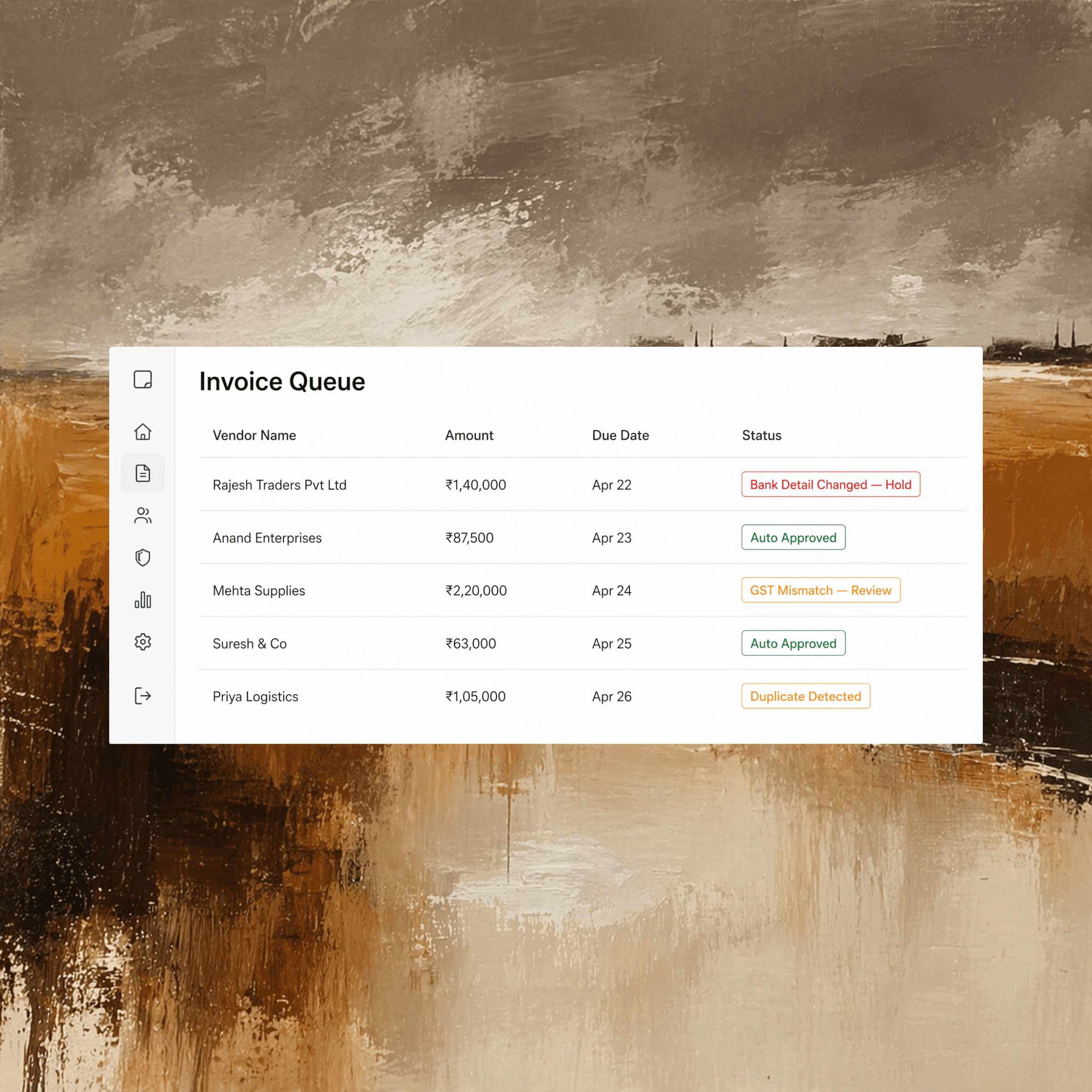
How to Evaluate AP Automation Software for Indian Mid-Market: The 8-Question Framework
Most AP automation demos look the same. These 8 questions expose whether a vendor actually handles Indian compliance — or just sells OCR with an Indian flag.
Verse HQ
Every AP automation vendor in India will show you the same demo: an invoice gets uploaded, the fields get extracted, the system routes it for approval, and it posts to Tally or Zoho. The demo looks clean. The pricing looks reasonable. The sales team is knowledgeable. Three months after go-live, you discover that the tool does not handle GST composition vendors, cannot detect rate drift against contracted prices, and sends every bank detail change to the same approval queue as a ₹500 stationery invoice.
These eight questions asked during the demo will tell you more than the standard walkthrough.
Eight Questions That Separate Real from Demo-Ready
Question 1: Show me what happens when a vendor invoice has a unit price 8% higher than the contracted rate. The system should flag the discrepancy, show the contracted rate from the contract document, calculate the rupee impact, and hold the invoice for review. A Level 1–2 tool will either pass it (if the PO total matches) or require a manual check. Ask specifically: does the comparison happen against the contract or only against the PO?
Question 2: How do you handle vendors who are not under the e-invoice mandate? Mandated vendors have IRN. Non-mandated vendors — which includes most smaller suppliers — do not. The system needs composite matching (GSTIN + invoice number + date + amount) for deduplication of non-mandate vendor invoices. If the answer is "we check IRN for all invoices," the tool has a blind spot for roughly 40–60% of a typical mid-market company's vendor base.
Question 3: A vendor's GSTR-1 has been filed consistently on the 18th instead of the 11th for the last 3 months. What does your system show? This should surface as a vendor-level risk flag — not just a monthly reconciliation discrepancy. If the system cannot track GSTIN filing behavior over time and score the ITC risk accordingly, it is doing point-in-time compliance checks rather than continuous vendor monitoring.
Question 4: Walk me through what happens when a vendor changes bank details. The correct answer: the system detects the new account number on the invoice, compares it against the vendor master and the last N invoices, flags it as a bank detail conflict at high severity, blocks the payment, and requires out-of-band verification before the vendor master can be updated. A routing question or an approval workflow response is not sufficient.
Question 5: How does TDS section determination work in your system? Section mapping should come from the vendor master — set at onboarding and applied automatically to every invoice from that vendor. The TDS base should exclude GST when GST is shown separately. Section 206AB applicability should be checkable against the Income Tax portal. If the answer involves manual calculation or per-invoice review, TDS errors will recur.
Question 6: Show me the audit trail for a flagged invoice. For a price mismatch flag, the audit trail should show: the invoice rate, the contracted rate, the specific contract clause, the PO quantity, the GRN confirmation, and the rupee impact. If the audit trail shows "price mismatch: ₹400 vs ₹380" without the source documents, the trail is a summary, not evidence.
Question 7: How does your system handle multi-location companies where different branches receive invoices from the same vendor? Duplicate detection must be cross-branch. ITC exposure must be consolidated. Vendor master changes must be reflected across all branches simultaneously. Branch-level data silos create the specific conditions where duplicate payments and fraud occur.
Question 8: What is the confidence threshold model for automated approval? The answer should describe a tiered confidence scoring system: high-confidence invoices auto-approved with full evidence logging, medium-confidence invoices surfaced for review, low-confidence invoices blocked. If the answer is binary approve/reject, the system is a rule engine, not an intelligence layer.
Ask all eight questions before selecting a vendor. The answers will sort the capability levels cleanly.