What Forensic AP Finds That Invoice OCR Cannot: The Intelligence Gap
OCR reads what's on the invoice. Forensic AP analysis cross-examines it against everything else you have. Here are the 6 things OCR misses — and what forensic analysis surfaces.
Verse HQ
OCR reads the invoice and extracts: vendor name, GSTIN, invoice number, date, line items, amounts, GST breakdown, bank details. This is accurate, consistent, and fast. It replaces manual data entry and eliminates keying errors. For a company processing 500 invoices per month, OCR-based extraction saves roughly 120–150 hours per month.
What OCR cannot do: tell you whether the extracted data is correct in context. Whether the unit rate on line 3 matches what was agreed. Whether the bank account number differs from the one this vendor used for the last 14 invoices. Whether this vendor has billed you for this scope three times this quarter. Whether the delivered quantity matches the GRN. Whether the GST non-compliance risk on this vendor is growing.
Those findings require Verse HQ's forensic AP analysis — cross-referencing every extracted signal against the full evidence chain. Here is what that produces beyond OCR.
Six Things OCR Cannot Find
Rate drift against contracted prices. OCR extracts the unit price on the invoice. It cannot compare that price against clause 4.2 of the contract signed 18 months ago, because the contract is not on the invoice. Over time, a vendor whose unit rates drift 2% per quarter stays below any per-invoice tolerance threshold while accumulating a 23% overpayment. Only full contract-invoice comparison — run on every invoice, every month — surfaces this. For a ₹2.4 crore annual vendor relationship, that is ₹55 lakh in recoverable overpayment that OCR passes through undetected.
Cross-vendor duplicate patterns. OCR checks for duplicates within a vendor's own invoice history. It cannot detect two different vendors billing for the same service delivery, with different invoice formats and different GSTINs, where the combined invoicing represents duplicate payment for one piece of work. This pattern requires cross-vendor transaction analysis that connects to POs and GRNs.
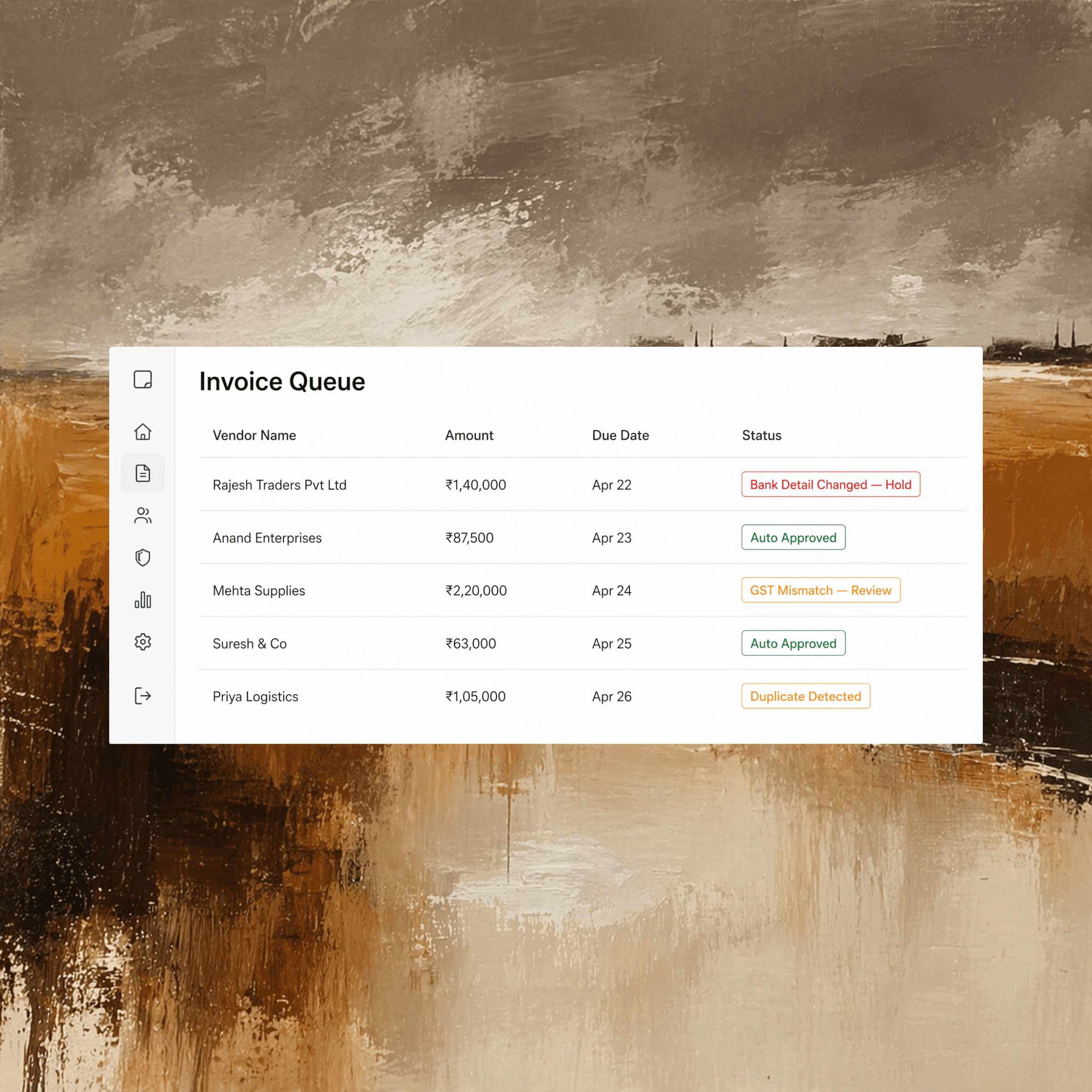
Bank detail conflicts against vendor master history. OCR reads the bank account number on this invoice. It does not compare it against the account number on the last 12 invoices from the same vendor or the account number in the vendor master. Forensic AP maintains a historical bank detail record per vendor and flags any deviation — immediately, before approval.
Short-delivery penalty calculations. OCR reads the invoice quantity. It cannot calculate whether the GRN quantity was below the contractual delivery threshold, read the relevant penalty clause from the contract, compute the penalty amount, and generate a credit note request. These are four steps across three documents. Only a system connected to all three — contract, GRN, invoice — can perform this calculation automatically. The typical unclaimed penalty accumulation: 0.2–0.5% of AP spend annually.
Vendor GST risk scores. OCR validates GSTIN format and active status at the moment of processing. It does not track whether this vendor's GSTR-1 has been filed consistently before the 11th, whether their GSTR-2B appearance rate has been declining over the last quarter, or whether their ITC risk profile has changed. These behavioral metrics require a vendor monitoring layer that is maintained over time.
Behavioral anomaly patterns. OCR processes each invoice independently. It does not track that this vendor's billing cycle changed from monthly to fortnightly three months ago, that their invoice amounts have been growing 6% per month, or that their last four invoices arrived with template changes. These patterns are only visible when invoice data is analyzed in sequence rather than in isolation.
What This Means for the Buying Decision
OCR is a necessary prerequisite — you need clean, structured data before you can do anything analytical with it. But the value of AP automation is not in extraction. It is in what you do with the extracted data.
A CFO choosing between an OCR-based AP tool and a forensic AP platform is choosing between faster data entry and actual intelligence. One replaces a manual task. The other surfaces findings that nobody was looking for — including the ones that directly recover margin.