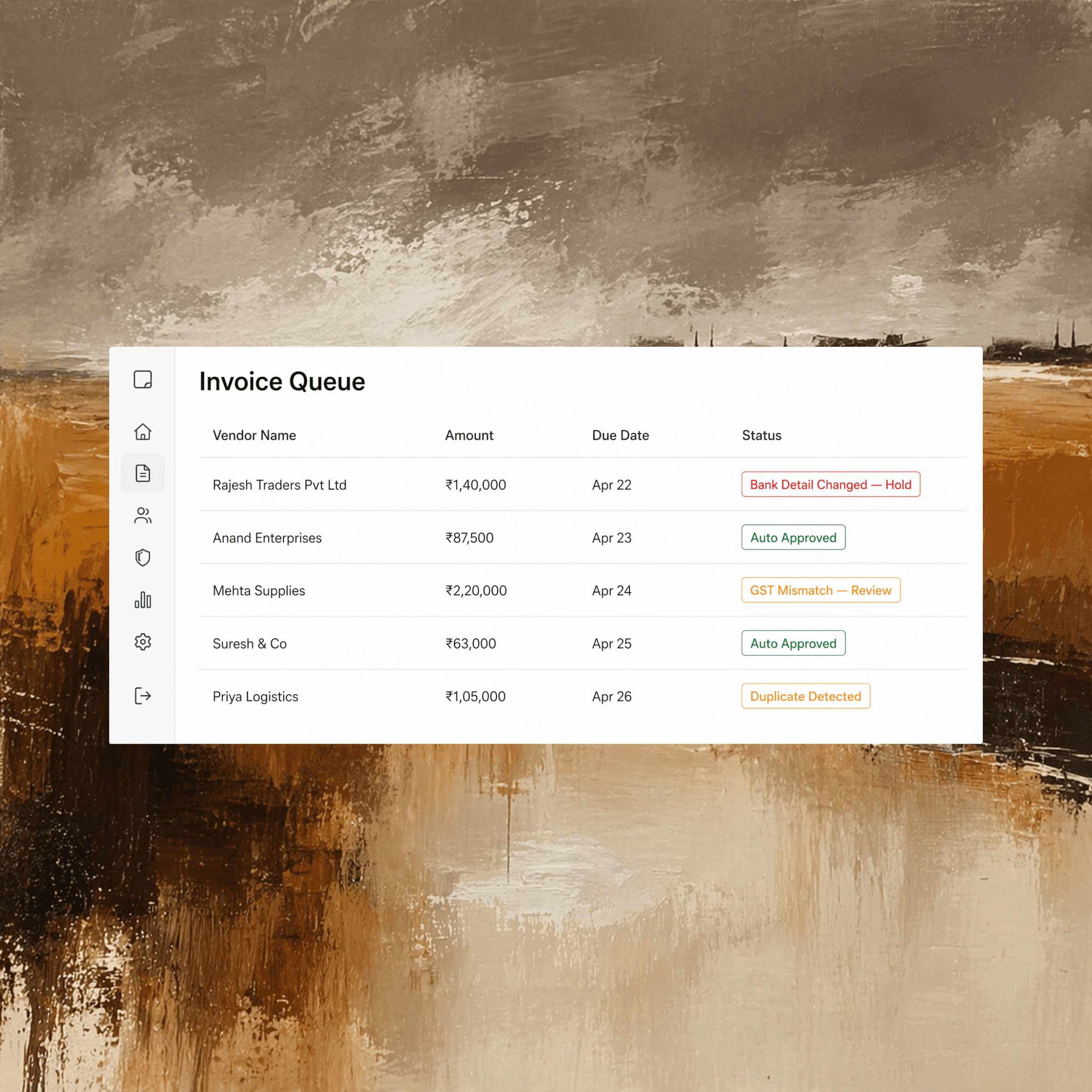
How Indian Mid-Market Companies Lose 1–3% of Revenue to AP Leakage — Without Knowing
Duplicate payments, overpaid rates, unenforced penalties, and blocked ITC typically add up to 1–3% of AP spend. Here's how each category contributes — and how it compounds.
Verse HQ
A ₹100 crore revenue company spending 45% of revenue on AP — ₹45 crore per year — has a leakage exposure of ₹45–₹135 lakh annually, depending on the maturity of their AP controls. That is the 1–3% figure. It does not arrive in one transaction. It accumulates across hundreds of invoices in five distinct categories, each invisible to standard AP processes, each recoverable with the right controls in place.
The Five Leakage Categories and Their Benchmarks
Price drift against contracted rates: 0.4–0.8% of AP spend.
Vendor unit prices that drift above contracted rates — either through incremental increases that stay within tolerance thresholds or through outright contract non-compliance — account for the largest single component of AP leakage. For a ₹45 crore AP base, this is ₹18–₹36 lakh per year.
The mechanism: no one checks invoice unit rates against contract price schedules at invoice processing time. PO matching confirms the invoice total against the PO value, but if both the invoice and the PO reflect the inflated rate (because the PO was raised against the vendor quote rather than the contract), the discrepancy only surfaces when someone compares the original contract to recent invoices.
Duplicate payments: 0.1–0.3% of AP spend.
Duplicate payments in Indian mid-market typically run 0.1–0.3% of AP spend at companies without automated deduplication. For ₹45 crore AP, that is ₹4.5–₹13.5 lakh per year. Some duplicates are recovered when vendors proactively notify. Others are never discovered. The recovery rate on identified duplicates averages 70–80% — vendors who received accidental double payment do not always return it voluntarily.
Unenforced short-delivery and late-delivery penalties: 0.2–0.5% of AP spend.
Contract penalty clauses are negotiated at procurement and forgotten at AP processing. When a vendor delivers below the contractual quantity threshold or delivers late against a committed date, the penalty calculation requires reading the contract, confirming the GRN data, and raising a credit note — a process that never happens manually at invoice processing time. Accumulated unclaimed penalties typically run 0.2–0.5% of AP spend for companies with active SLA clauses in vendor contracts.
Blocked ITC and interest cost: 0.2–0.4% of AP spend.
For a company at ₹45 crore AP with 18% average GST rate, the ITC pool is ₹8.1 crore annually. ITC blocked by vendor non-compliance and filing delays — that is deferred or lost, not just delayed — typically represents 6–10% of the pool. The cash cost: deferred ITC reduces working capital, and ITC that becomes a reversal attracts 18–24% interest. The total cash impact runs ₹9–₹18 lakh per year.
TDS errors and associated penalties: 0.1–0.2% of AP spend.
Incorrect TDS calculations — wrong section, GST-inclusive base, missed Section 206AB — result in demand notices with interest at 1.5% per month. For ₹45 crore AP with typical TDS obligations, a 3% error rate on TDS calculations creates ₹4.5–₹9 lakh in annual penalty exposure.
What the Aggregate Looks Like
For a ₹100 crore company with ₹45 crore AP:
Leakage Category | Annual Range (₹ lakh) |
|---|---|
Price drift | 18–36 |
Duplicate payments | 4.5–13.5 |
Unenforced penalties | 9–22.5 |
Blocked ITC and interest | 9–18 |
TDS errors | 4.5–9 |
Total | 45–99 lakh |
The midpoint is ₹72 lakh — 1.6% of AP spend, or 0.72% of revenue. For a company with 8–12% EBITDA margins, this represents 6–9% of annual operating profit leaking through the AP function.
The leakage is recoverable. None of these categories require exceptional circumstances — they are systematic gaps in controls that exist at nearly every mid-market company that has not implemented contract-level AP validation. The question is not whether the leakage exists. The question is whether the CFO has the visibility to see it and the tools to stop it.