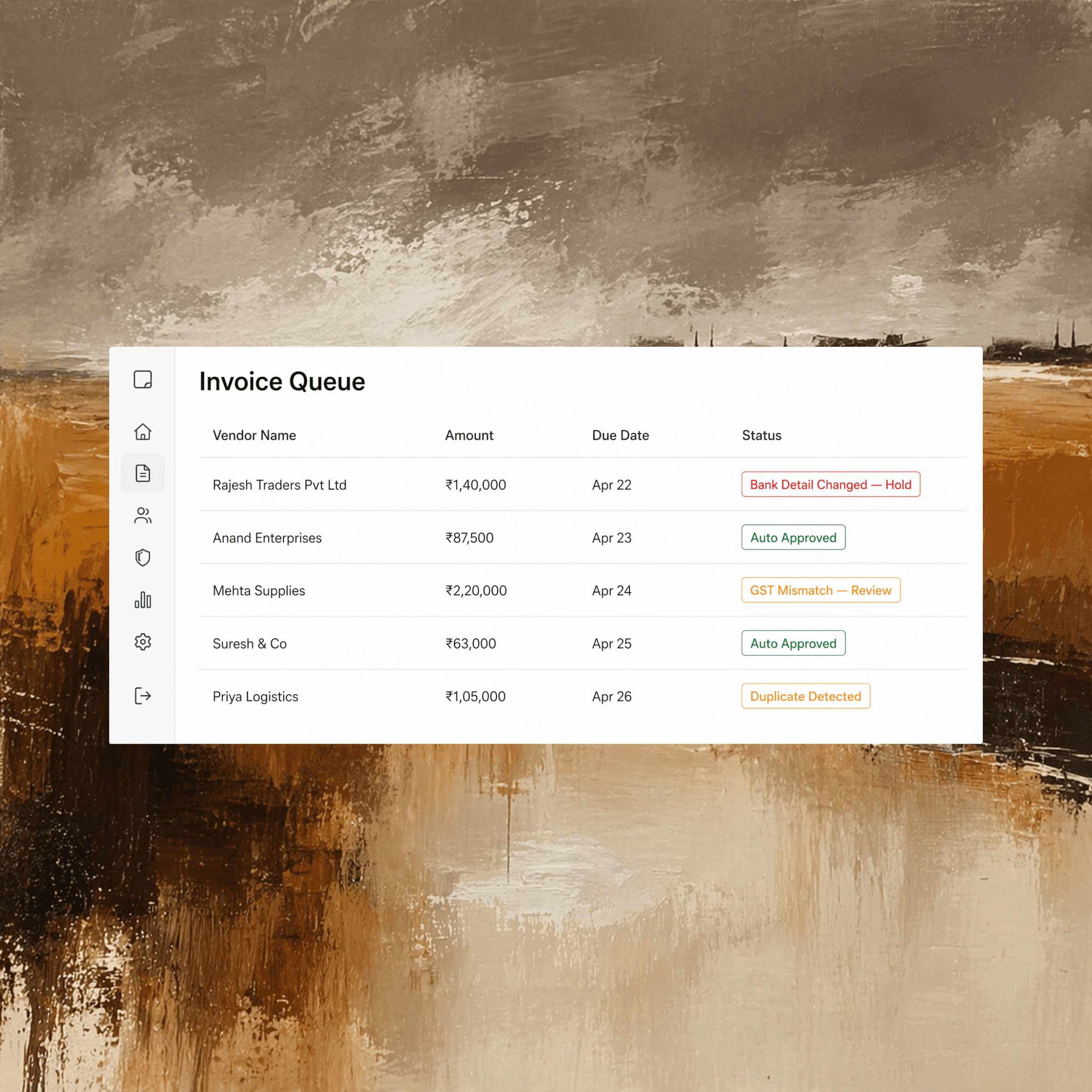
What Happens When AI Reads Your Invoices Against Your Contracts
Invoice OCR reads what's on the page. Contract matching checks whether what's on the page matches what was agreed. Here's the difference — and what it surfaces.
Verse HQ
An invoice for ₹3.6 lakh arrives from a vendor your team knows well. The GSTIN is valid. The IRN checks out. The amount matches the PO total within tolerance. Every individual check passes. Your AP team approves it. What nobody checked: clause 4.2 of the vendor contract specifies ₹340 per unit for orders above 500 units. This invoice has 1,050 units at ₹343 per unit — a ₹3,150 line-item overpayment that looks small but recurs monthly. Over 18 months, that is ₹56,700 in contractual non-compliance that passed through every existing control.
The Difference Between Extraction and Validation
Every AP tool available today can read an invoice. OCR extracts the fields — vendor name, invoice number, amount, GST breakdown, bank details. This is the extraction layer. It answers the question: what does the invoice say?
Validation answers a different question: is what the invoice says consistent with what was agreed? The agreed terms are in the contract, not the invoice. They include unit price schedules that may vary by volume tier, payment terms that may differ from what the invoice claims, GST rate allocations for specific HSN codes, and SLA clauses that trigger penalties when delivery conditions are not met.
The gap between extraction and validation is where most AP leakage lives. An invoice that correctly states ₹343/unit and ₹3,60,150 total is accurate as a document. It is non-compliant as a transaction, because the contract says ₹340/unit for this volume band.
What Contract-Level Matching Actually Does
The check requires the contract to be accessible in the same system as the invoice. Not in a shared drive folder, not in a separate contract management system, not in an email thread — accessible in a way where the invoice processing step can compare against it automatically.
When the contract is available, matching operates at clause level: the system reads the price schedule, identifies the applicable volume tier for this PO quantity, extracts the contracted unit rate, and compares it to the invoice unit rate. If the delta exceeds a defined tolerance, the invoice is flagged with the specific clause, the contracted rate, the invoiced rate, and the rupee impact.
This same logic applies to payment terms. A contract specifying Net-45 but an invoice claiming Net-30 is not a minor formatting difference — it is a ₹X lakh payment being accelerated by 15 days, which has a real cash flow cost. Platforms like Verse HQ do this clause-level verification as part of standard AP processing, connecting every invoice to its full evidence chain.
Short-delivery penalty clauses require both contract reading and GRN data. If the contract says delivery below 95% triggers a 1.5% penalty and the GRN shows 91% delivery, the calculation requires: reading the penalty clause from the contract, confirming the GRN quantity against the contractual threshold, calculating the penalty amount (1.5% of the invoice value), and generating a credit note request. This is a four-step cross-document process that AP teams almost never perform manually.
Why This Matters at Scale
The challenge with contract-level validation is not that any individual check is complex. It is that the checks need to happen across every invoice, every month, against contracts that may be 40 pages long, written in mixed English and Hindi, with rate schedules that reference volume tiers in clause 7 while delivery SLAs are in clause 11.
This is not a problem that scales through human review. A finance team reviewing 500 invoices per month against their corresponding contracts would need to add significant headcount just for contract compliance checking. The alternative — not doing the check — means that price drift, unenforced penalties, and payment term violations accumulate invisibly until someone notices something looks off.
The question the contract matching layer answers is not "is this invoice correct?" It is: "is this invoice consistent with what we agreed to pay, and are we claiming everything we are owed?"