AI in Accounts Payable India: What It Actually Does vs What Vendors Claim
AI accounts payable tools in India range from OCR with a chatbot to genuine multi-document cross-referencing. Here's how to tell the difference.
Verse HQ
Every AP software vendor in India currently uses the word "AI" in their marketing. Some of them mean it. Most mean they have OCR with a rule engine, a workflow tool with approval routing, or a dashboard with a chatbot interface. The distinction matters because a CFO evaluating AP automation is choosing between tools at very different capability levels — and the pricing and the demos do not always make the gap obvious.
Here is a practical taxonomy of what AP automation actually looks like at each level, and what questions expose where a vendor sits.
Four Levels of AP Automation Capability
Level 1 — Extraction. The system reads the invoice, pulls the key fields (vendor name, GSTIN, invoice number, date, amounts, GST breakdown), and puts the data into a structured format for ERP entry. This eliminates manual data keying. It does not validate anything. An incorrect GST rate, a wrong quantity, a bank detail that doesn't match the vendor master — none of these are caught. This is OCR with data routing. Most tools marketed as "AI-powered invoice processing" are at this level.
Level 2 — Workflow automation. The system routes invoices through an approval workflow based on rules — amount thresholds, department codes, vendor types. It sends reminders when approvals are pending. It integrates with Tally or Zoho Books to post approved entries. This eliminates manual follow-up and routing overhead. It still does not validate the transaction against its source documents. The invoice gets approved faster; whether it should be approved is still a human judgment call with minimal data support.
Level 3 — Validation intelligence. The system checks the invoice against the PO for price and quantity match, detects duplicates using IRN or composite matching, validates GSTIN activity, and flags basic anomalies. This is where most mid-market AP automation tools that claim "AI" actually sit. It catches around 70–80% of invoice errors at the field-validation level. What it does not catch: contract non-compliance, behavioral patterns, unenforced penalty clauses, or rate drift over time.
Level 4 — Forensic intelligence. The system cross-examines the invoice against the full evidence chain: PO, GRN, contract, vendor history. It checks unit rates against contracted price schedules. It calculates whether short-delivery penalties apply. It tracks behavioral baselines and flags deviations. It builds a vendor risk score from GST filing behavior, dispute history, and payment patterns. This is the level at which AP automation becomes intelligence — not just faster processing, but genuine analytical output. The 3% of invoices that require human judgment get routed with full evidence; the 97% that are clean get processed automatically.
How to Tell the Difference in a Demo
Three questions that expose capability level: First — "Show me what happens when an invoice arrives with a unit price that is 8% above the contracted rate." A Level 3 tool will pass this invoice if the total is within PO tolerance. A Level 4 tool will flag the rate against the contract and show the specific clause.
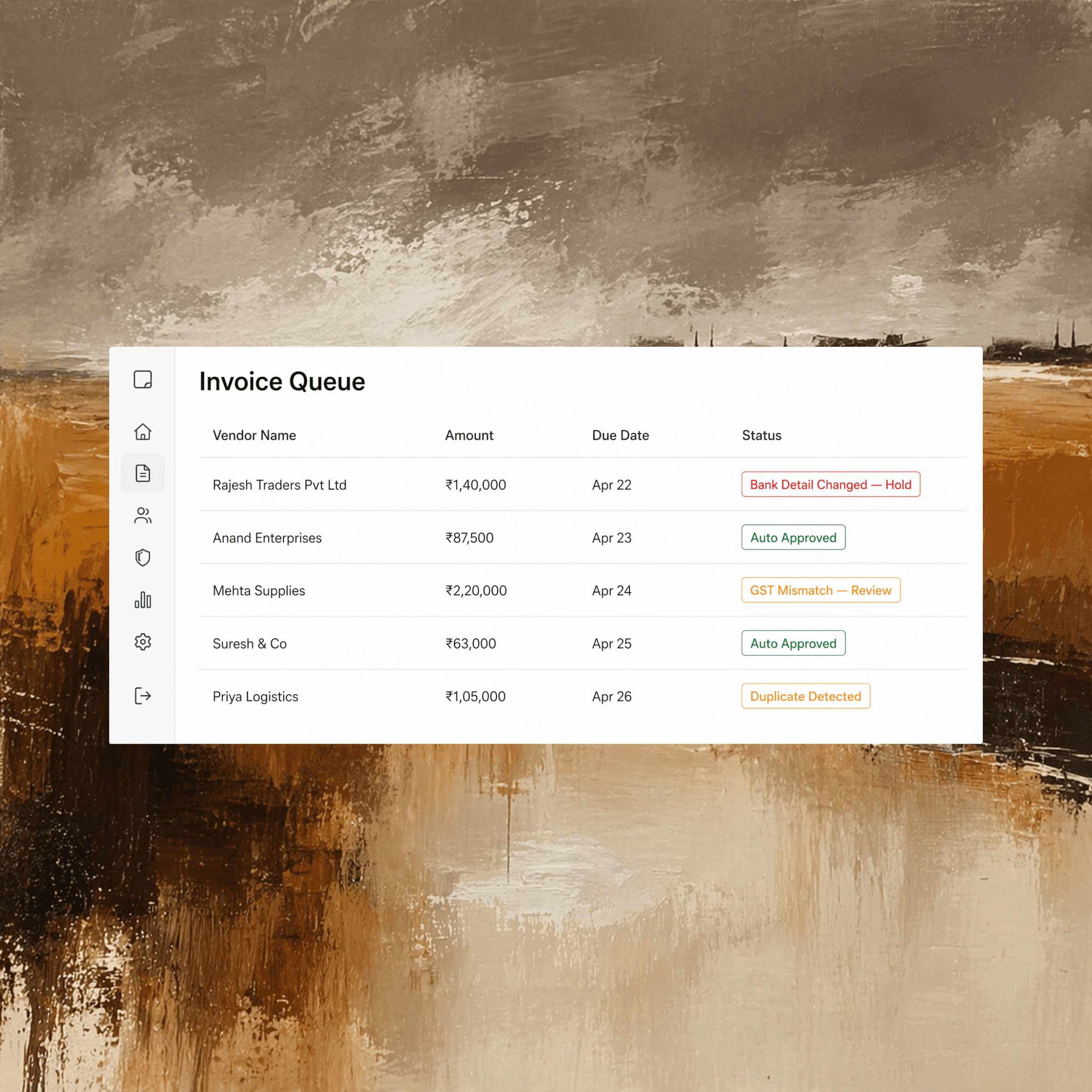
Second — "A vendor just changed their bank details. Walk me through what happens in your system." A Level 2 tool will update the vendor master when instructed. A Level 4 tool will flag the change as a high-severity event, require out-of-band verification, and compare the new account against the historical record.
Third — "How does your system handle a vendor whose GSTR-1 filing has been consistently late for 3 months?" A Level 3 tool may flag non-compliant GSTIN status. A Level 4 tool tracks filing behavior over time, scores the vendor's ITC risk, and surfaces the risk before the next invoice arrives.
The marketing will not tell you which level a tool is at. The demo will, if you ask the right questions.