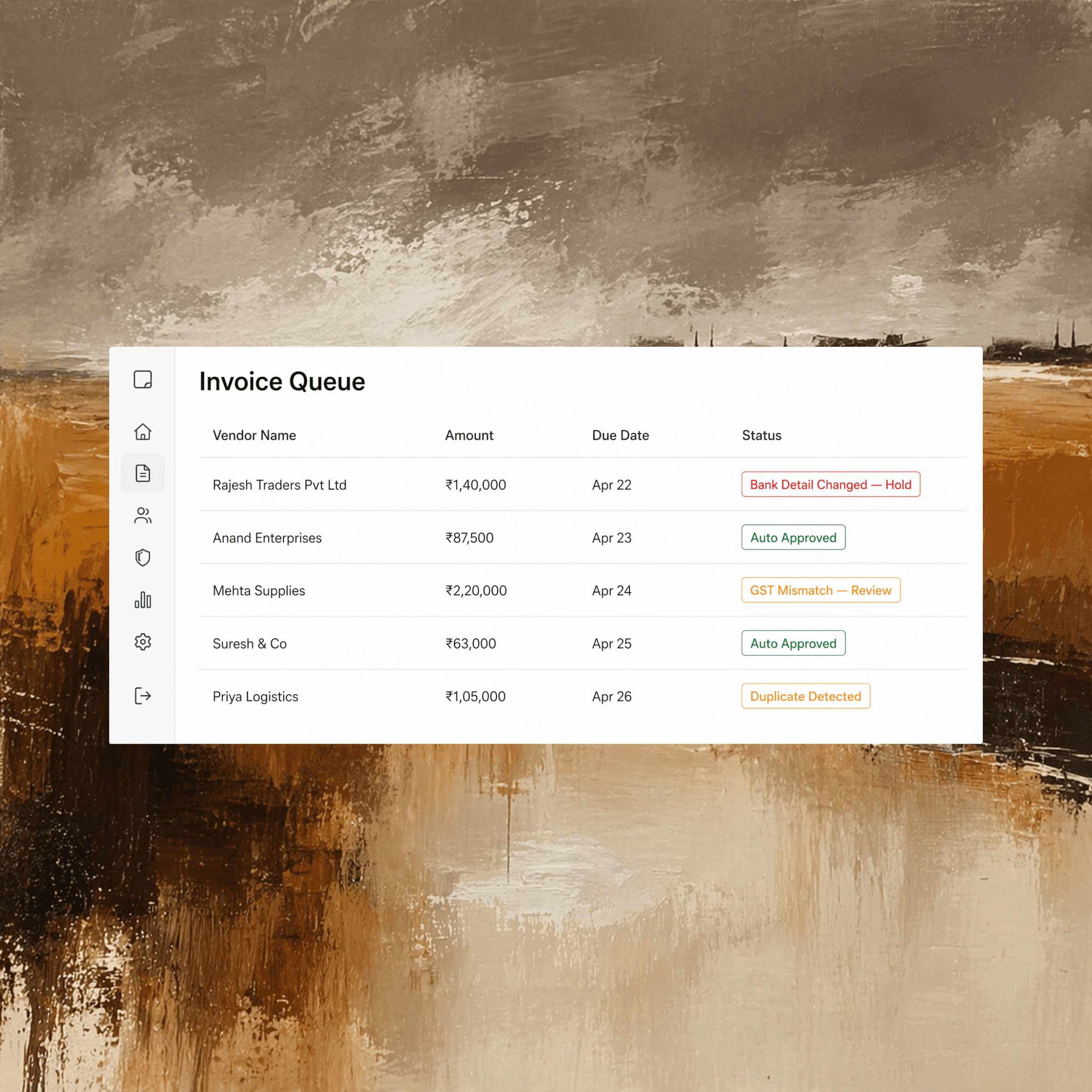
The Vendor Intelligence Layer: Why Knowing Your Vendors Isn't Just Compliance
Vendor risk isn't just about whether a GSTIN is valid. A vendor's payment pattern history, billing behavior, and GST filing regularity tell you things a compliance check never will.
Verse HQ
A vendor your company has worked with for four years was reliable by every observable metric: invoices arrived on time, amounts were reasonable, GST filings were consistent. In month 28, their invoice amounts started growing 6% per month. In month 31, bank details changed for the first time. In month 33, their GSTR-1 filings became irregular. None of these signals, individually, would have triggered a review. Together, they describe a vendor under financial stress — or a vendor relationship that has been compromised.
This is what vendor intelligence looks like in practice: not a compliance check, but a longitudinal behavioral profile that reveals patterns over time.
What a Vendor Profile Actually Contains
A vendor profile built from transaction history is more than a vendor master record. It is a behavioral signature — the observable pattern of how this vendor interacts with your company over time.
Transaction history. Every invoice: amount, date, quantity billed, amount paid, exceptions raised. Aggregated over 12–24 months, this creates a baseline. Deviations from that baseline — invoice amounts growing faster than contracted rates, billing frequency changing without explanation, exception rates increasing — are signals worth examining.
GST compliance trajectory. Not just current GSTIN status, but GSTR-1 filing dates over the last 12 months, GSTR-2B appearance rate, and ITC claim reliability. A vendor whose GSTR-2B appearance rate has been declining for three consecutive months has a developing compliance problem. Catching this in month 3 rather than month 8 changes the ITC recovery cost significantly.
Bank detail history. Every bank account number that has appeared on this vendor's invoices, in sequence, with dates. One change in three years: low significance. Two changes in six months: high significance. This single historical record is the primary defense against bank detail fraud — and most AP teams do not maintain it.
Dispute and exception history. How many invoices from this vendor required corrections? What types of exceptions — TDS disputes, quantity mismatches, price variances, missing GRNs? A vendor with a rising exception rate is either growing their business faster than their billing process can handle, or their billing process has become less reliable for reasons worth understanding.
Why Cross-Vendor Intelligence Compounds the Value
Vendor intelligence becomes more valuable when it is shared across companies, not just maintained per buyer. A vendor who is systematically overbilling one customer is a problem. A vendor who shows the same overbilling pattern across multiple customers is a signal with different implications — it may indicate a deliberate practice rather than an accidental billing error.
When the same vendor flag appears across three or more companies using the same AP platform, it becomes a network signal. The individual buyer's data confirms the transaction. The network confirms the pattern. This cross-tenant intelligence cannot be replicated by any individual company analyzing their own AP data in isolation — it requires a shared platform where the vendor's behavior across the network is visible.
For the CFO evaluating AP intelligence platforms, the data moat question is worth asking: does the platform get smarter over time as more transactions are processed? Does it learn from corrections? Does it benefit from cross-customer vendor patterns? A platform that learns compounds its value — each month of operation makes the vendor behavioral baselines more accurate and the anomaly detection more precise.
From Vendor File to Vendor Intelligence
Most Indian mid-market companies maintain a vendor master that records what vendors are — registration details, bank accounts, contact information. Vendor intelligence records what vendors do over time — how they bill, when they file, how reliable their delivery has been, what their ITC track record looks like.
The shift from vendor file to vendor intelligence changes what questions the finance team can answer. Not just "is this vendor compliant?" but "is this vendor's compliance trending in the right direction?" Not just "did this invoice look right?" but "is this invoice consistent with everything we know about this vendor's history?"