What Three-Way Matching Actually Checks — And Why Most Indian AP Teams Don't Do It
Three-way matching compares PO, GRN, and invoice at line-item level before approving payment. Here's what it checks — and why manual matching fails at volume.
Verse HQ
A vendor delivers 180 units. The GRN is raised for 180. The invoice says 200 units at ₹450 each — ₹90,000. Your AP team checks the total, sees it matches a recent PO, and approves payment. The vendor was paid for 20 units that were never delivered. This is not a fraud scenario — it is a data entry error on the vendor's side. But without three-way matching, the overpayment goes undetected until the vendor's next GRN reconciliation, if that reconciliation ever happens.
Three-way matching in accounts payable means checking the purchase order, the goods receipt note, and the vendor invoice against each other before releasing payment. Most Indian mid-market finance teams do this conceptually — someone glances at the PO and the invoice. The gap is in the execution: the check happens at document level, not line-item level.
What Line-Item Matching Actually Checks
At line-item level, three-way matching compares four things: invoice quantity versus GRN accepted quantity, invoice unit price versus PO agreed price, invoice total versus PO approved value, and GST rate on the invoice versus the applicable rate for that HSN or SAC code.
The quantity check is the most straightforward. If the GRN shows 180 units received and the invoice bills for 200, that discrepancy is ₹9,000 at ₹450/unit — and the payment should be for 180 units, not 200. What makes this hard manually is that the GRN confirmation often comes from the warehouse team via WhatsApp or email, and the AP team is processing the invoice from a PDF in a different system. The GRN and the invoice rarely sit in the same view at the same time.
The price check requires comparing against the PO. This is where tolerance thresholds matter. A ₹2 rounding difference per line item is not worth disputing. A 3% unit price variance across 500 units is ₹6,750 on a single invoice — worth flagging. Getting the threshold right is a business decision, and it should be explicit: "we accept up to ₹50 variance per line item, anything above requires review."
The connection to GST ITC is direct. Under Section 16 of the CGST Act, ITC is eligible only for goods or services actually received. An invoice for goods not reflected in a GRN creates a compliance risk beyond the payment risk — the ITC claimed may be reversed.
Why Manual Three-Way Matching Breaks Down at Volume
A finance team processing 50 invoices per month can manually pull the PO for each invoice, find the GRN confirmation in their email, and compare quantities. A team processing 400 invoices per month cannot sustain this. The GRN confirmations are in email, in WhatsApp, in the ERP, and sometimes on paper. The matching happens in someone's head rather than in the system. The result: invoices get approved because the total looks right, not because the line items were verified.
The operational reality in Indian mid-market companies: the warehouse team confirms deliveries on their own timeline. Month-end pressure means that by day 3 of the next month, 80 invoices are waiting on GRN confirmation. Under that pressure, the AP team starts approving invoices based on the PO match alone — the GRN check falls away.
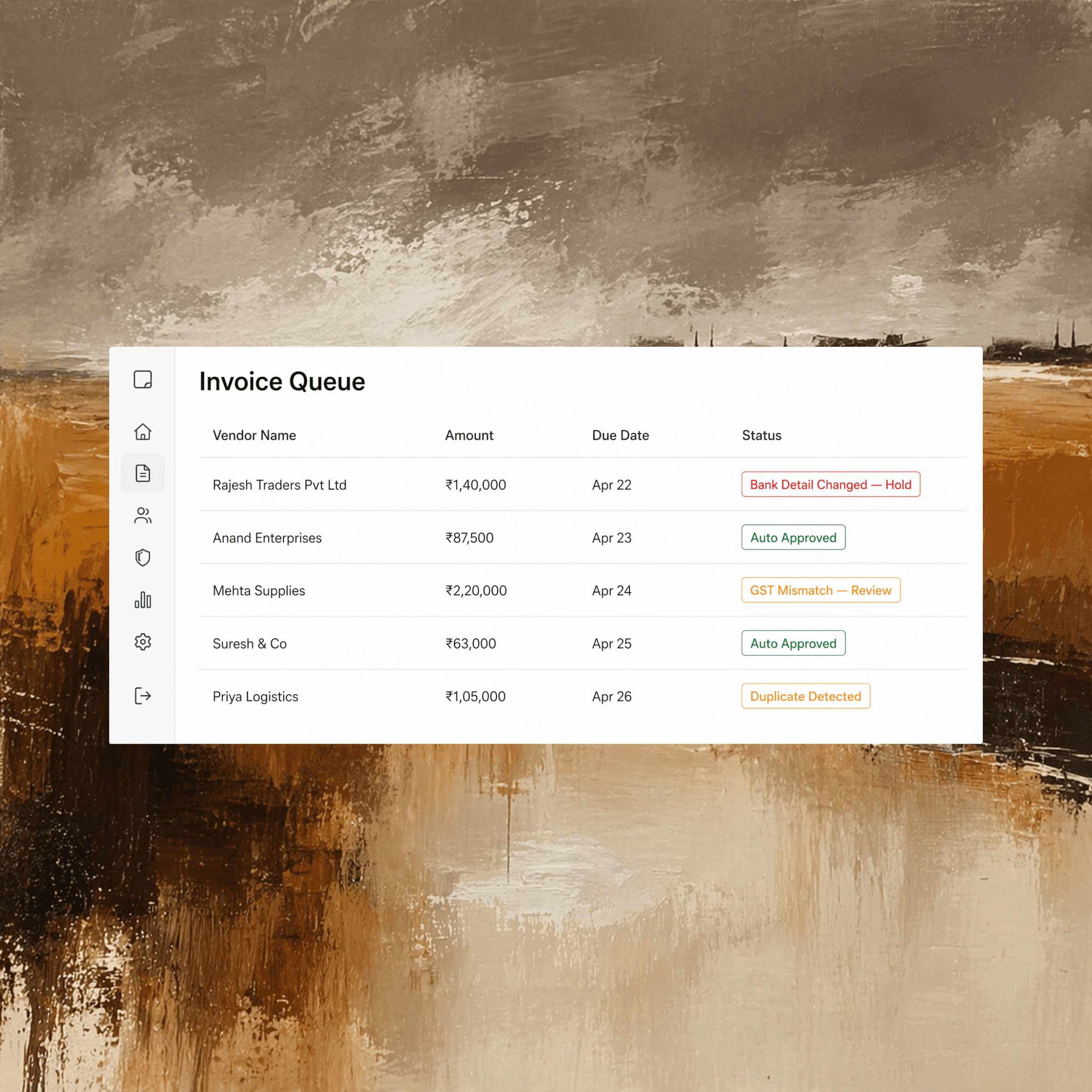
Automated three-way matching resolves 75–85% of invoices without human intervention — those with clean quantity, price, and total matches. The remaining 15–25% that have discrepancies get routed for review with the specific mismatch flagged and the rupee impact calculated.
The value of three-way matching is not primarily in catching large frauds. It is in surfacing the small, systematic variances — 3% unit price drift, consistent 10-unit overbilling — that compound into significant overpayments across a year of invoices.